Home / How to get rid of mold
How to get rid of mold
The EPA's step-by-step method for cleaning mold at home, what protective gear to use, and the point where Florida law says it becomes a licensed job.
Talk to a local provider: (000) 000-0000Updated November 6, 2026. Every statement is linked to the agency that made it.
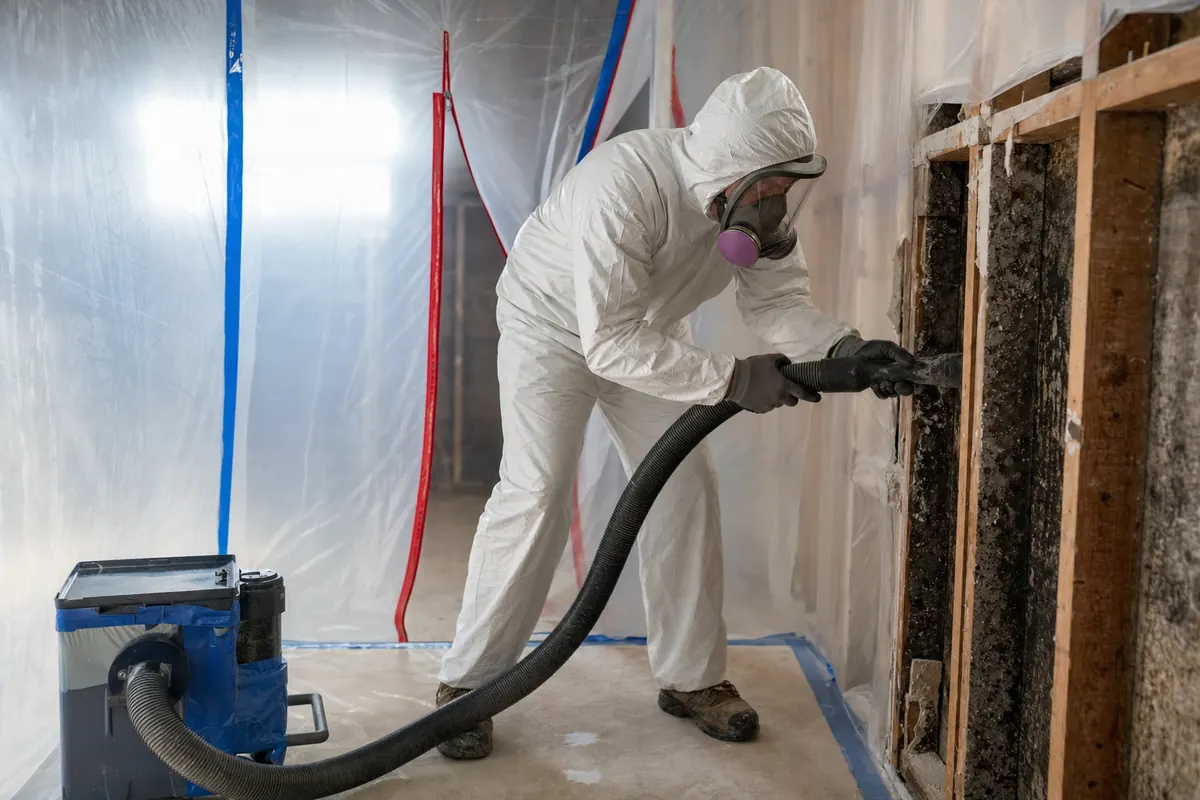
Before you start: is this a DIY job?
- The EPA says homeowners can usually handle a moldy area smaller than about 10 square feet (roughly 3 ft by 3 ft)[1]. In Florida, remediation of more than 10 square feet is licensed work[2][3]; homeowners do not need a license for their own home[4].
- Call a professional if the water was sewage or otherwise contaminated[1], if the HVAC system may be contaminated[1], or if you smell mold but cannot find it[1].
- People with asthma or other breathing problems, or with weakened immune systems, should stay away from moldy areas[5].
What to wear
- An N-95 respirator, sold at many hardware stores[1]; the CDC says upgrade to a half-face or full-face respirator for long jobs such as tearing out moldy drywall[6].
- Gloves to mid-forearm[1] and goggles without ventilation holes[1]; goggles with open vents will not stop small particles[6].
- Long sleeves, long pants and boots or work shoes for flood cleanup[5].
Step by step (EPA method)
- Fix the water first. Stop leaks and dry everything completely[7]. Cleanup is not finished until the moisture problem is fixed[1].
- Contain it. Florida's UF/IFAS Extension advises turning off the AC and taping plastic over air grilles so spores do not spread[8].
- Scrub hard surfaces with detergent and water, then dry completely[7]. Clean gently the first time to avoid stirring up dust[5], and wait to run fans until visible mold has been cleaned[5].
- Remove what cannot be cleaned. Porous materials such as ceiling tiles and carpet may have to be thrown away[1].
- Do not paint or caulk over mold; paint over mold is likely to peel[7] and will not stop growth[9].
- Dry before you rebuild. Drying often takes days to weeks[5]; the EPA says materials should read 15% or less on a moisture meter before refinishing[5].
- Change and shower after working in a moldy area so you do not carry it back into living space[9].
Note that the goal is not a sterile house: a background level of spores always remains and will not grow once the moisture is fixed[1]. Want to know about bleach or vinegar? See vinegar vs. bleach for mold.
Hiring a professional
- The EPA says to check that a contractor has mold experience, check references, and ask them to follow EPA, ACGIH or IICRC guidelines[7]. The EPA itself does not certify or list contractors[5].
- In Florida, check the individual remediator's license (type MRSR) on DBPR's Verify a Licensee search[10]. Typical costs are on our mold remediation cost page.
Questions
Can I remove mold myself?
For small areas, usually yes. The EPA says homeowners can usually handle an area smaller than about 10 square feet[1], and Florida does not require a license for work in your own home[4].
Can I just paint over mold?
No. The EPA says not to paint or caulk over mold; clean and dry it first[7].
Sources
Every figure on this page links to its source. Statutes are from the 2026 Florida Statutes. FEMA and NOAA figures were downloaded on 6 November 2026.
- A Brief Guide to Mold, Moisture and Your Home. U.S. Environmental Protection Agency. https://www.epa.gov/mold/brief-guide-mold-moisture-and-your-home Accessed 6 Nov 2026.
- Section 468.8411, 2026 Florida Statutes. The Florida Senate (Florida Statutes). https://www.flsenate.gov/Laws/Statutes/2026/468.8411 Accessed 6 Nov 2026.
- Section 468.8419, 2026 Florida Statutes. The Florida Senate (Florida Statutes). https://www.flsenate.gov/Laws/Statutes/2026/468.8419 Accessed 6 Nov 2026.
- Section 468.841, 2026 Florida Statutes. The Florida Senate (Florida Statutes). https://www.flsenate.gov/Laws/Statutes/2026/468.841 Accessed 6 Nov 2026.
- Flood Cleanup to Protect Indoor Air and Your Health. U.S. Environmental Protection Agency. https://www.epa.gov/emergencies-iaq/flood-cleanup-protect-indoor-air-and-your-health Accessed 6 Nov 2026.
- Mold Clean Up. U.S. Centers for Disease Control and Prevention. https://www.cdc.gov/mold-health/about/clean-up.html Accessed 6 Nov 2026.
- Mold Cleanup in Your Home. U.S. Environmental Protection Agency. https://www.epa.gov/mold/mold-cleanup-your-home Accessed 6 Nov 2026.
- Cleaning Mold After a Flood (PDF) [UNIVERSITY EXTENSION]. University of Florida IFAS Extension (UF/IFAS blog-hosted handout). https://blogs.ifas.ufl.edu/news/files/2019/08/Cleaning-Mold-after-a-Flood.pdf Accessed 6 Nov 2026.
- Homeowner's and Renter's Guide to Mold Cleanup After Disasters (PDF). U.S. Environmental Protection Agency (multi-agency guide, footer dated June 2015). https://www.epa.gov/sites/default/files/2017-08/documents/mold._homeowners_and_renters_guide_to_cleanup_after_disasters.pdf Accessed 6 Nov 2026.
- Mold-Related Services. Florida Department of Business and Professional Regulation. https://www2.myfloridalicense.com/mold-related-services/ Accessed 6 Nov 2026.
- Mold Course Chapter 1. U.S. Environmental Protection Agency. https://www.epa.gov/mold/mold-course-chapter-1 Accessed 6 Nov 2026.